What Is Reinforcement Learning? How Enterprises Use It to Optimize Decisions

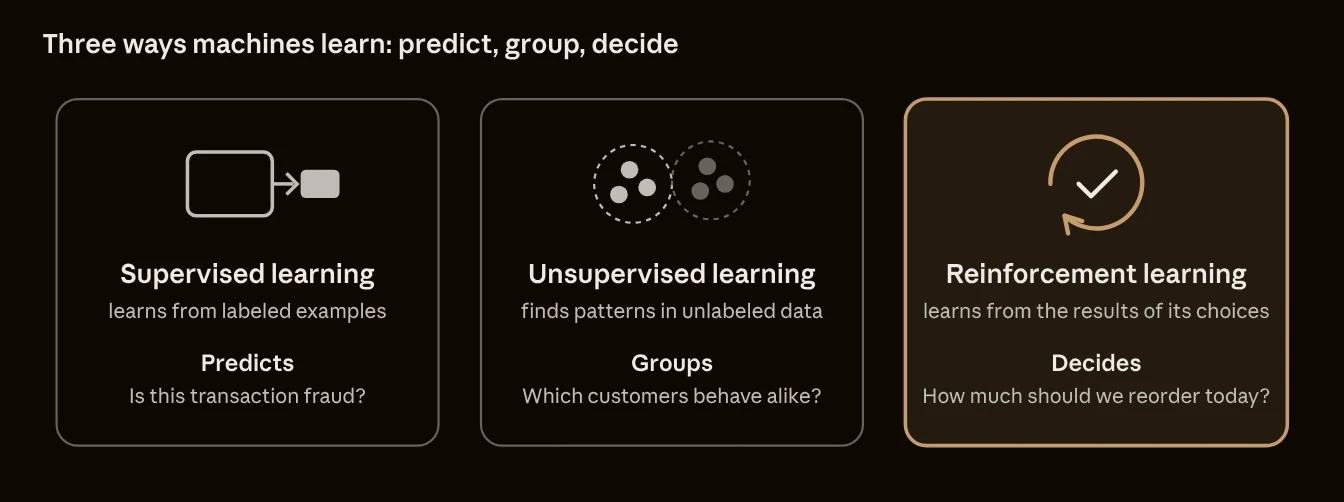
Short answer: Reinforcement learning (RL) is a type of machine learning that learns decision-making policies from rewards and feedback. Instead of predicting only what might happen, an RL agent learns which actions to take to improve outcomes over time.
For enterprises, reinforcement learning is particularly relevant when decisions repeat, conditions change, and each action can influence future results.
Examples include inventory replenishment, warehouse operations, workforce scheduling, energy management and financial portfolio research.
But reinforcement learning is not the right solution for every decision. Business rules, traditional optimization, supervised machine learning and RL often work best together.
Key takeaways
- Reinforcement learning learns which actions to take to improve outcomes over a sequence of decisions, not just what might happen next.
- It fits decisions that repeat, change with conditions and influence future results, such as inventory replenishment, workforce scheduling and energy management.
- It is one tool among several: rules, optimization and supervised learning often work best alongside it, and a learned policy must beat a strong existing baseline before it is used.
Reinforcement learning in plain terms
Consider a contact center deciding how many employees to schedule throughout the day.
Staff too few agents and customers wait longer. Staff too many and operating costs increase. Today's staffing decisions can also influence tomorrow's backlog and workload.
A reinforcement learning system can be designed around five elements:
- State: Current queue length, forecast demand, available staff and operating conditions.
- Action: How many agents to schedule or assign to particular tasks.
- Reward: A measurable score balancing service levels, customer waiting times and operating costs.
- Policy: The strategy that maps the current state to an action.
- Environment: The real operation or a simulator that responds to those actions.
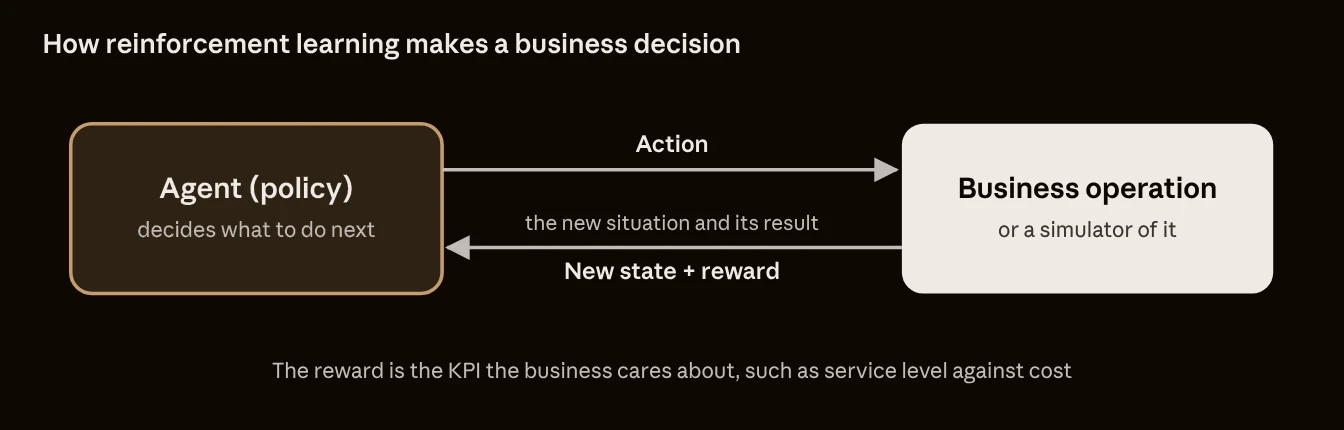
The agent learns through interaction with the environment or suitable historical decision data.
The objective is not necessarily to maximize the immediate reward. It is to develop a policy that performs well over a sequence of decisions.
This ability to consider future consequences is what makes RL interesting for dynamic business operations.
How reinforcement learning differs from other machine learning
Three commonly used approaches have different learning objectives.
| Approach | How it learns | Typical business application |
|---|---|---|
| Supervised learning | Learns patterns from labeled examples | Demand forecasting, fraud classification |
| Unsupervised learning | Discovers structure in unlabeled data | Customer segmentation, anomaly detection |
| Reinforcement learning | Learns policies from rewards and experience | Inventory replenishment, scheduling, resource allocation |
These categories are useful for understanding the differences, although modern AI includes additional learning approaches.
Where does deep learning fit?
Deep learning uses multilayer neural networks to learn representations and complex relationships in data. It can be applied within supervised learning, unsupervised learning and reinforcement learning.
When neural networks are used to represent an RL agent's policy, value function or environment model, the approach is commonly called deep reinforcement learning (DRL).
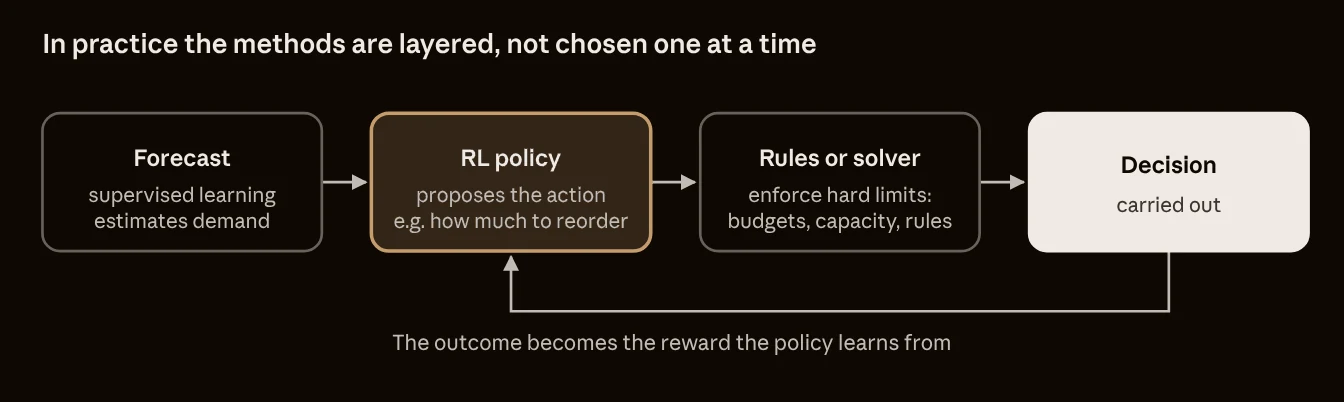
For example, supervised learning might forecast tomorrow's demand, while a deep RL policy uses that forecast, current inventory and delivery lead times to determine how much stock to reorder.
The two approaches are complementary.
Reinforcement learning versus business rules and optimization
Reinforcement learning is not a replacement for every existing decision system.
| Approach | Where it works well | Key consideration |
|---|---|---|
| Rules and heuristics | Straightforward, stable processes | Complex exceptions can make rules difficult to maintain |
| Mathematical optimization | Well-defined objectives and constraints | Requires an appropriate model and updated inputs |
| Supervised learning | Predicting outcomes from historical examples | Predictions must be translated into actions |
| Reinforcement learning | Repeated decisions with long-term consequences | Requires reliable rewards, experience or simulation, and careful evaluation |
Modern optimization methods can also adapt to changing conditions. Rolling-horizon optimization, stochastic optimization and model predictive control are powerful alternatives.
The important question is not whether RL is more advanced. It is whether a learned policy offers measurable improvement over a strong existing approach.
In many practical architectures, the methods are combined: forecasts estimate demand, an RL policy proposes actions, and a rules engine or mathematical solver enforces hard constraints.
How enterprises can use reinforcement learning
Several business operations involve recurring decisions, uncertain conditions and measurable outcomes.
| Business function | Example decision | Potential optimization objective |
|---|---|---|
| Supply chain | How much inventory to reorder, when and where | Margin, availability and holding costs |
| Logistics | Which delivery or vehicle assignment to make next | On-time delivery, fleet utilization and cost |
| Workforce operations | How to schedule and assign employees | Service levels, waiting times and labor costs |
| Financial services | How to allocate resources or evaluate constrained portfolio decisions | Risk-adjusted outcomes and compliance constraints |
| Energy management | When to charge EV fleets or operate storage systems | Energy cost, operational readiness and safety |
| Customer engagement | Which next-best action to recommend | Long-term customer value and experience |
These are potential application areas, not claims that RL has already improved each of them in production.
The suitability of RL depends on the decision frequency, feedback quality, available data, environment dynamics and strength of existing alternatives.
Financial, employment and other consequential decisions additionally require appropriate regulatory, fairness and human oversight controls.
Reinforcement learning for AI models and agents
RL also plays an increasingly important role in training language models.
In reinforcement fine-tuning, a language model generates responses or actions, receives reward feedback and updates its behavior.
For tasks with objectively checkable outcomes, reinforcement learning with verifiable rewards (RLVR) can use programmatic checks such as calculation verification, test-suite results or schema validation.
This differs from an operational RL agent optimizing inventory or scheduling decisions. Both use reward-driven learning, but their environments, actions, training procedures and evaluation methods can differ considerably.
What makes reinforcement learning valuable?
For suitable problems, RL offers several potential advantages:
- Sequential decision-making: Optimizes a sequence of actions rather than evaluating each decision independently.
- Long-term objectives: Can account for delayed benefits and costs when these are properly represented in the reward and evaluation design.
- Complex operating conditions: Can learn policies using interacting variables such as demand, available capacity, lead times and costs.
- Business-aligned evaluation: Policies can be measured against operational KPIs such as margin, service level, throughput and resource utilization.
- Simulation-based experimentation: Candidate policies can be evaluated in a controlled environment before limited real-world testing.
However, these benefits are not automatic. Reward design, data quality, simulator fidelity and comparisons with credible baselines determine whether the learned policy is useful.
How reinforcement learning works in practice
A responsible enterprise RL project generally follows a staged approach:
- Define the decision: Identify what action can be changed and which KPI matters.
- Understand the environment: Capture states, actions, constraints, delayed effects and available data.
- Establish baselines: Measure current business rules or optimization strategies.
- Train candidate policies: Use an appropriate simulator, logged experience or a combination of methods.
- Evaluate independently: Compare candidates against baselines using held-out scenarios, multiple runs and relevant operational metrics.
- Deploy cautiously: Begin with shadow evaluation or a limited rollout where feasible, with monitoring, safeguards and rollback procedures.
Simulation results are evidence, not guarantees of production performance. An RL policy must also be evaluated for how it behaves when real operating conditions differ from training assumptions.
For technical teams: main reinforcement learning methods
Different decision problems require different learning techniques.
- Value-based methods estimate the expected future value of possible actions. Q-learning and Deep Q-Networks (DQN) are common examples.
- Policy-gradient methods directly optimize a parameterized decision policy. Proximal Policy Optimization (PPO) is a widely used example.
- Actor-critic methods combine policy learning with estimates of value. PPO and Soft Actor-Critic (SAC) are examples of algorithms in this broader family.
- Model-based RL uses a known or learned model of environment dynamics to support planning or policy improvement.
- Offline RL learns from previously collected experiences without requiring new interactions during training. This can be particularly relevant when exploring new actions in production would be expensive or unsafe. However, the coverage and quality of historical data place important limits on what can be learned reliably.
The appropriate algorithm depends on the problem's state and action spaces, the availability of experience, operating constraints, and evaluation requirements.
How OptRL approaches reinforcement learning
At OptRL, we focus on applying reinforcement learning to measurable decision problems rather than introducing RL simply because a process can be automated.
Our RLX platform supports the engineering workflow around RL environments, reward design, training and evaluation.
The OptRL Playground lets visitors explore interactive reinforcement learning environments, including:
- Warehouse robotics: Learn navigation and pickup-and-delivery behavior in a simulated warehouse.
- Inventory replenishment: Explore how policies make replenishment decisions under changing demand.
- Stock trading: Experiment with simulated portfolio allocation and trading decisions using market data.
These environments demonstrate how agents can learn and how their behavior can be evaluated. Playground results are research demonstrations, not verified production outcomes or promises of financial or operational returns.
Our engineering approach emphasizes reproducible experiments, meaningful baselines, realistic constraints and measurable results before deployment decisions are made.
When is reinforcement learning not the right choice?
RL may be unnecessary when a decision is infrequent, conditions are stable, a simple rule works reliably, or an existing optimization method already meets the business objective.
It may also be unsuitable when reliable outcomes cannot be measured, relevant historical data is insufficient, or an adequately validated simulator cannot be developed.
The strongest solution is the one that delivers measurable value with acceptable cost, complexity and risk, whether it uses reinforcement learning or not.
Where should an enterprise start?
Identify one recurring decision that currently depends on static rules, manual intervention or frequent adjustments.
Ask whether its outcome is measurable, whether today's actions affect future conditions, and whether existing methods leave significant room for improvement.
Then establish a baseline and evaluate alternatives before committing to a new learning system.
Have a recurring business decision you want to improve? Explore the OptRL Playground to see reinforcement learning in action, or book a 30-minute call with OptRL to discuss how that decision could be evaluated against your current approach.
About OptRL: OptRL helps enterprises improve the decisions they make thousands of times a day, from operational choices such as inventory, warehouse operations and resource allocation to AI agents and language models, using reinforcement learning where it fits. Its RLX platform takes each decision problem from environment audit and reward design through training, evaluation and deployment. For language models, its Adaptive Fine-Tuning method trains open-weight models against the outcomes a business already records. Everything runs inside the client's own environment, alongside the AI stack already in place. OptRL fixes both sides of agent failure: retrieval for what a model sees, and training for how it chooses.
References
- Sutton and Barto, Reinforcement Learning: An Introduction, second edition, MIT Press (2018)
- Watkins and Dayan, Q-learning, Machine Learning 8 (1992)
- Mnih et al., Human-level control through deep reinforcement learning, Nature (2015)
- Schulman et al., Proximal Policy Optimization Algorithms (2017)
- Levine, Kumar, Tucker and Fu, Offline Reinforcement Learning: Tutorial, Review, and Perspectives on Open Problems (2020)
- Boute, Gijsbrechts, van Jaarsveld and Vanvuchelen, Deep reinforcement learning for inventory control: A roadmap, European Journal of Operational Research (2022)
Written by
Maanit Shah